
Mastering Flexibility (Without Blowing Out Your Chops)
Why “lip slurs” are really about air—and why they’re one of the most efficient things you can practice
Key: C (start here, then move chromatically)
Tempo: Slow and controlled
Time: 10–15 minutes
Focus: Flexibility / air coordination
Why: Flexibility develops range, endurance, and sound all at once—without excess strain
The Goal of Flexibility Practice
If you’ve followed my practice notes at all, you know efficiency is always the goal. We want the most improvement for the least amount of wear and tear.
When it comes to trumpet playing, flexibility exercises, or “lip slurs”, are one of the most efficient tools you can use.
But the name itself is misleading.
Flexibility isn’t really about the lips. In fact, focusing too much on the lips often slows progress and creates tension. What actually controls pitch changes during slurs is air and the shape of the oral cavity.
The lips vibrate.
The air does the work.
Understanding this changes how you practice—and how quickly you improve.
What Flexibility Really Is
Flexibility is the ability to move smoothly through the harmonic series on a single valve combination using continuous air, without tonguing and without valves.
Pitch changes happen because of air speed, not pressure.
A helpful way to think about this is through vowel shapes:
Low notes feel like “Ah” or “Oh.”
Higher notes move toward “Ee.”
As the tongue arches slightly, the air speeds up—much like placing your thumb over the end of a garden hose. The water doesn’t get stronger; it just moves faster.
This is why many teachers argue that “air slurs” or “tongue slurs” would be more accurate names.
Why This Is Such Efficient Practice
Flexibility exercises address multiple fundamentals at once:
Endurance: Proper slurring teaches you to rely on air instead of mouthpiece pressure.
Range: Vertical movement through the harmonic series is a primary engine for extending the upper register.
Tone quality: Clean slurs require steady, uninterrupted air.
Few other exercises give you that much return on investment in a short period of focused practice.
The Exercise
Think of this less as an exercise and more as a focused habit.
Start simply.
Pick a comfortable starting pitch—Low C is ideal. Using a backing track or drone if you like, slur from Low C up to G and back down:
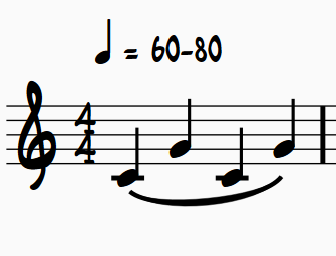
Keep the air moving the entire time. Change the vowel shape smoothly from “Ah” to “Ee” and back.
If you hear a bump or a gap, the air stopped. Don’t force it—slow down and reconnect the airflow.
Once that feels comfortable, repeat the same pattern on all valve combinations, descending chromatically.
From there, you can begin extending upward:
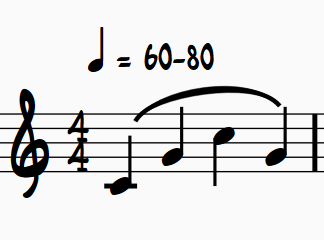
Don’t reach for the top note. Emphasize the bottom note and let the air “spring” you upward.
This work is mentally demanding at first, but the harmonic payoff is enormous.
Suggested Materials
If you want structured flexibility studies to work from, these are three classic books that many players use to build strength, range, and smooth motion through the harmonic series:
• Advanced Lip Flexibilities by Charles Colin - A foundational book focused on clean, controlled flexibility across registers. This is my favorite book to work from right now.
• 27 Groups of Exercises by Earl Irons - Classic flexibility and embouchure coordination studies that many teachers recommend for daily use.
• Lip Flexibility on the Trumpet by Walter M. Smith - A clear, methodical collection of flexibility studies focused on smooth coordination and efficient movement through the harmonic series.
(Affiliate links above help support this newsletter at no extra cost to you.)
How to Use This in Practice
This is where flexibility work really earns its place in a time-efficient routine.
Keep sessions short and focused. Ten to fifteen minutes is plenty when done correctly.
Rest as much as you play. If you slur for 30 seconds, rest for 30 seconds. This is non-negotiable.
Sound comes first. If the tone spreads or strains, slow down. Clean, resonant sound matters more than speed or range.
Avoid pressure. If you have to mash the mouthpiece into your face to make it work, something upstream isn’t coordinated yet. Let the air do the job.
When practiced this way, flexibility becomes sustainable instead of exhausting.
Final Thought
Think of flexibility exercises as the vegetables of your practice diet.
They may not be as immediately exciting as playing solos, but they quietly build the foundation that makes everything else easier—range, endurance, sound, and control.
A small, consistent dose goes a very long way.
More next week.
— Jim